
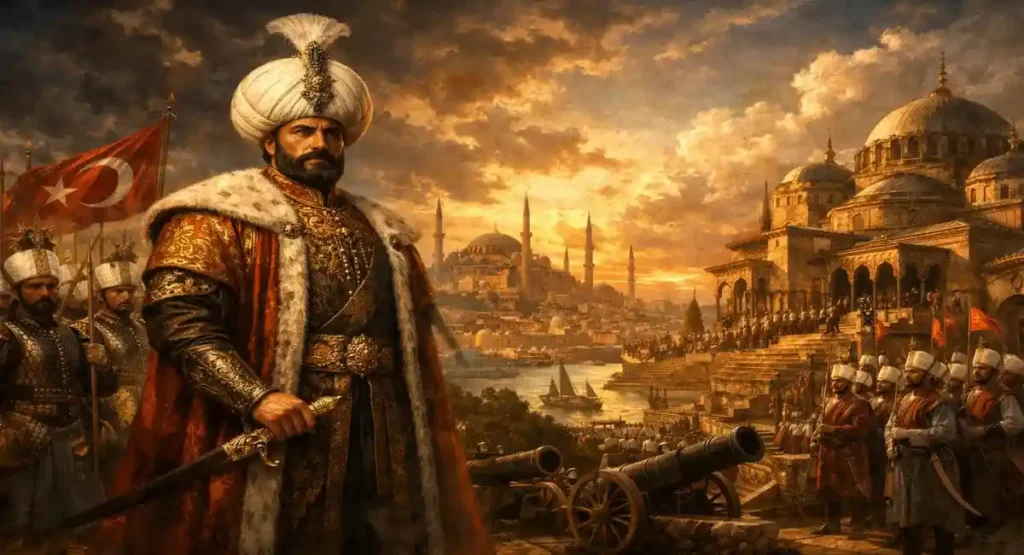
History of the Ottoman Empire: Rise, Glory, and Fall of a Powerful Empire
The Ottoman Empire stands as one of the most powerful and long-lasting empires in world history. Spanning over six centuries, it played a crucial role in shaping modern Europe, the Middle East, and North Africa. From its humble beginnings in Anatolia to becoming a global superpower, the Ottoman Empire’s history is a fascinating journey of conquest, culture, and transformation.
In this blog, we will explore the rise, expansion, golden age, decline, and fall of the Ottoman Empire while also covering important insights useful for high CPC keywords like world history, empire rise and fall, Islamic history, geopolitics, and military strategy.
Origins of the Ottoman Empire
The Ottoman Empire was founded around 1299 by Osman I, a Turkish tribal leader in Anatolia (modern-day Turkey). The empire gets its name from Osman himself.
At that time, the region was politically unstable after the decline of the Seljuk Empire, giving Osman an opportunity to establish his own rule.
Key Factors Behind Early Growth:
- Weak neighboring states
- Strategic geographic location
- Strong military leadership
- Religious motivation (Ghazi warriors)
Expansion and Conquest
The Ottomans quickly expanded under Osman’s successors. One of the most important milestones was the conquest of Constantinople in 1453 by Mehmed II.
Why Constantinople Was Important:
- It was the capital of the Byzantine Empire
- Strategic trade hub between Europe and Asia
- Strong economic and military advantage
This victory marked the end of the Byzantine Empire and established the Ottomans as a major world power.
The Golden Age of the Ottoman Empire
The Ottoman Empire reached its peak during the reign of Suleiman the Magnificent (1520–1566).
Achievements During the Golden Age:
- Expansion into Europe, Asia, and Africa
- Advanced legal and administrative systems
- Flourishing art, architecture, and culture
- Strong economy and trade networks
Military Power
The Ottoman army, especially the Janissaries, was one of the most disciplined and powerful forces in the world.
Economy & Trade (High CPC Insight)
The empire controlled major trade routes, making it a center for:
- International trade
- Silk Road commerce
- Tax revenue systems
This makes the topic highly relevant for high CPC keywords like global trade, economic history, and financial systems.
Culture and Society
The Ottoman Empire was a multicultural and multi-religious society. It included Muslims, Christians, and Jews living under a system known as the Millet System.
Key Cultural Contributions:
- Islamic architecture (mosques like Blue Mosque)
- Calligraphy and literature
- Advances in science and medicine
Governance System
The Sultan held absolute power, but administration was well-structured with ministers and advisors.
Decline of the Ottoman Empire
From the late 17th century, the empire began to weaken due to several factors.
Major Reasons for Decline:
- Military defeats in Europe
- Corruption in administration
- Economic problems
- Rise of European powers
- Internal revolts
The empire was often referred to as the “Sick Man of Europe” during this period.
World War I and the Fall
The Ottoman Empire sided with the World War I, which proved to be a fatal decision.
After losing the war, the empire collapsed, and its territories were divided among Allied powers.
In 1922, the Ottoman Empire officially ended, and Mustafa Kemal Atatürk established the Republic of Turkey in 1923.
Legacy of the Ottoman Empire
Even today, the impact of the Ottoman Empire can be seen in:
- Middle Eastern politics
- European history
- Cultural traditions
- Legal systems
Modern Relevance (High CPC Angle)
This topic connects strongly with:
- Geopolitics
- International relations
- Military strategy
- Economic systems
Conclusion
The history of the Ottoman Empire is a powerful example of how leadership, strategy, and geography can shape the destiny of nations. From its rise under Osman I to its peak under Suleiman the Magnificent and eventual fall after World War I, the empire’s journey is both inspiring and cautionary.
For students, historians, and researchers, understanding the Ottoman Empire provides valuable insights into world history, political systems, and economic development.
